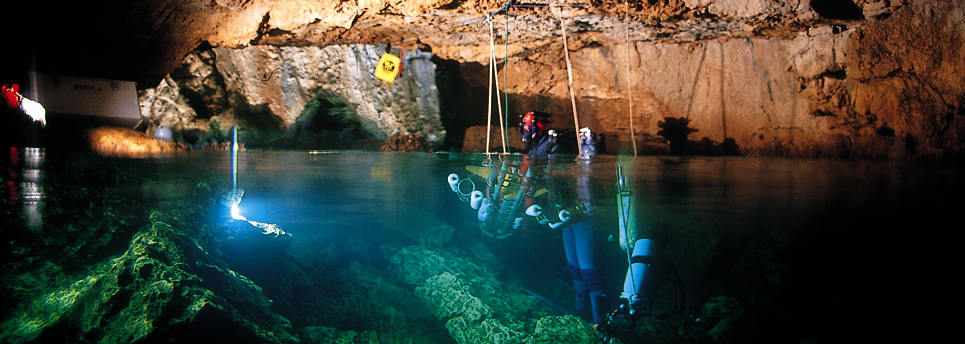
Near the Cova dels Arcs, a few meters to the south is the entrance to the Moraig underground river, also known as Riu Blanc. An underwater upwelling through which the Benissa aquifer discharges. This cavity consists of a wide gallery from which a main conduit begins, which, in depth, branches, creating forks and galleries. Explorations carried out by underwater speleologists have made it possible to recognize 2 km of completely submerged conduits, which reach a depth of 60 meters below sea level. Its exit lagoon is located next to the vertical wall of the Moraig Falla.
The Benissa aquifer, with a surface area of 270 km2, is limited to the east by the sea (between Cap de Sant Antoni and Morro de Toix), to the north by the Sierra del Montgó, to the west by the Sierra de la Solana and the Tàrbena basin and, to the south, by the Sierra de Bèrnia.
It is a coastal karst aquifer formed by carbonate rocks, which are in direct contact with the sea, so there is a hydraulic connection between the salt water of the sea and the fresh water of the aquifer. The entry of seawater through the karstified carbonate rocks explains the high salinity. It is, therefore, a salinized freshwater spring.
The paths through which seawater circulates are not known but the observations made lead us to consider that the water enters through the sinkhole of the Cova dels Coloms, in Morro de Toix (located between Altea and Calp), crosses the aquifer system of the Benissa depression through approximately 20 km of karstic conduits, and resurfaces through the underwater upwelling of the Moraig, in El Poble Nou de Benitatxell.
This system of sinkholes and galleries, formed by different galleries, wells and forks, constitutes, together with that of the Greek island of Kephalina, a unique hydrogeological phenomenon in the world and it remains to be discovered if it is the deepest underwater river in Europe.
In March 1998, the Conselleria d’Obres Públiques, Urbanisme i Transport promoted the «Technical assistant for drafting the recovery study of the aquifer of the Benissa Depression (Marina Alta – Alicante)». Within the framework of said study, complementing a classic hydrogeological study, multiparametric instruments were installed in both cavities, recording time series at 30-minute intervals for a period of 18 months. The parameters measured with this instrument were: temperature, conductivity, pressure, intensity and direction of flow. Through the Moraig upwelling, the average discharge flow was estimated at 900 l/s.
The Riu Blanc or Riu del Moraig is only accessible to caving divers with high knowledge and specialized equipment. And despite the high level of knowledge, the cavity is extremely dangerous due to its only route and exit to the surface, so there is a risk of getting trapped.
A group of speleodivers from different origins have formed the Moraig Caving Group (GEM). Since 2013 they have aimed to expand the study of the river, its topography and the internal life of the cavity. Thus, they continue the work carried out in their day by divers such as Bernhard Pack or José María Cortés, who delved up to 1,125 m.
This aquifer in El Poble Nou de Benitatxell began to be investigated in 1974. Eloy Parra was the first diver to dive into the cavity up to 200 meters. Later, Juan José Palmero and Vicente Alegre continued the work of Parra and unfortunately died inside.
Bernhard Pack and José María Cortés managed to go to a much greater distance, always with the location of fresh water in mind. They reached 1,125 meters along the main road and 60 meters deep and also surveyed two side galleries of about 300 meters each. Tragically, Pack lost his life inside the cave, after leaving important documentation of the aquifer system.
Currently, the physical reality of the Riu Blanc and its drainage systems are still to be discovered and continue to arouse technical interest among specialists.