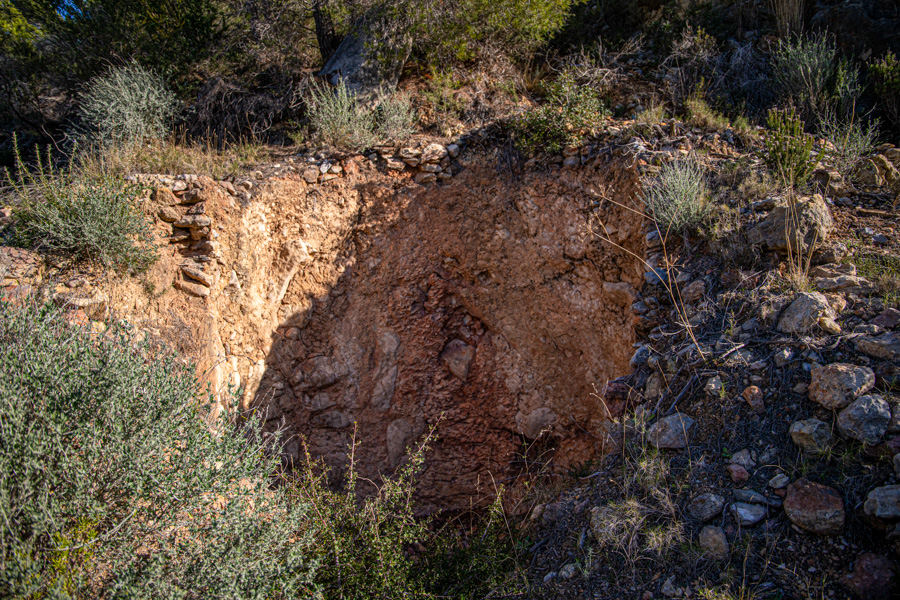
quarry. In November 2018, a limestone quarry was discovered, probably dates from the Roman’s time. This material had different uses, especially in architecture, being very important to make ashlars and keystones, or hydraulic pipes, as well as to manufacture dams or mills. The quarry men were in charge of extracting the stones they modeled later. The extraction process had several phases. First, the land was cleared and removed until the site was discovered.
Once the quarry face was ready, the extraction began from outside to inside, and from top to bottom, forming steps or terraces. Next, the block to be extracted was delimited, indicating the cut with a groove of about 10 cm. On this point, with a punch, the holes were made where the wooden or iron wedges were inserted in a row. It broke the rock due to the pressure that they had made, and finally separated the block.
If you look carefully, you can see a marked block that was not removed. The block’s measures were normalized around the Roman foot, about 30 cm, or multiples of this unit. Once the part had been separated, it had to be polished and left there to give it a uniform shape, so that the finishing touches could be made in the workshops, according to the final use. The different extracted fronts of this quarry ended up configuring these stands.